
No products in the cart.
4%

74192 (4-bit synchronous up/down decade counter)(japan)
In Stock
In Stock
Add to WishlistRemove from Wishlist
CompareAdd to Wishlist
Description
The 74192 is a versatile 4-bit synchronous up/down decade counter.
You can preset its value using parallel load inputs (Input A – Input D) by setting Load to low.
It counts up when the UP input transitions from low to high and down when the DOWN input transitions from low to high. Clearing the counter to zero is achieved by setting CLR to high. The Terminal Count up (CO) goes low before reaching zero and returns to high at zero, while Terminal Count Down (BO) does the same in the count-down mode. For larger counting ranges, you can cascade multiple counters by connecting CO and BO outputs to Clock-Up (UP) and Clock-Down (DOWN) inputs of the next significant counter, respectively.
IC 74192 Counter Specifications
|
Feature |
Specifications |
|
High-Speed (fMAX) |
54 MHz (Typical) at VCC = 5 V |
|
Low Power Dissipation |
ICC = 4 µA (Maximum) at TA = 25 °C |
|
High Noise Immunity |
VNIH = VNIL = 28% VCC (Minimum) |
|
Output Drive Capability |
Can drive 10 LSTTL (Low Power Schottky TTL) Loads |
|
Symmetrical Output Impedance |
|IOH| = IOL = 4 mA (MIN.) |
|
Balanced Propagation Delays |
tPLH = tPHL (Symmetrical) |
|
Wide Operating Voltage Range |
VCC (OPR) = 2 V to 6 V |
|
Pin and Function Compatibility |
Compatible with 54/74LS192-193 |
74192 IC Function
-
Decimal Counting
The 74192 is a 4-bit counter, which means it can count from 0 to 9 in decimal (0000 to 1001 in binary). This makes it particularly useful in applications where you need to keep track of decimal values, such as digital clocks, timers, or systems that require decimal counting sequences.
-
Reset to Zero
The IC features a clear input (CLR) that allows you to reset the counter to zero at any time by applying a high signal to this input. This is essential for starting a counting sequence from the beginning or for manual control over when the counter should be reset.
-
Preset Capability
The 74192 IC enables you to preset the counter to a specific value before counting begins. This is accomplished by loading a binary value onto its data inputs (Input A – Input D) and then triggering the asynchronous parallel load input (Load) with a LOW signal. This preset capability is valuable in scenarios where you need the counter to start from a non-zero initial value.
-
Bi-Directional Counting
The IC can count in both directions – up and down. It increments the count value on the low-to-high transition of the UP input and decrements the count value on the low-to-high transition of the DOWN input. This bi-directional counting feature provides flexibility for various counting and sequencing tasks.
-
Carry and Borrow Outputs
The 74192 IC generates carry (CO) and borrow (BO) signals during its counting operation. CO goes low half a clock period before the counter reaches its maximum count (9 in decimal) during an up-count operation and returns to a high level at the zero count. BO functions similarly during a down-count operation. These outputs are essential for cascading multiple counters, allowing you to create multidigit counters with ease.
-
Multidigit Counter Construction
One of the primary applications of the 74192 IC is in constructing multidigit counters. By connecting the CO output of a lower-order counter to the UP input of a higher-order counter and the BO output to the DOWN input, you can create counters with larger bit widths. This cascading capability enables you to count and sequence to higher values efficiently.
-
Synchronous Operation
The 74192 operates synchronously, meaning that the counting and other operations are synchronized to a clock signal. This synchronous operation ensures that the counter behaves predictably and accurately, making it suitable for a wide range of digital applications.
74192 Pinout
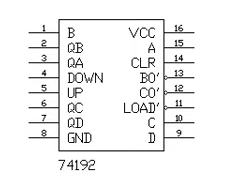
74192 ic pin diagram/ 74192 ic pin configuration
74192 Truth Table
BCD, or Binary Coded Decimal, is a common counting sequence in which each decimal digit is represented by a 4-bit binary code. In a BCD decade counter, the counting sequence is as follows:
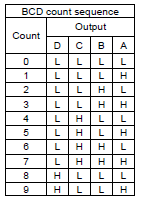
Up-Counting Sequence:
- 0000 (0 in BCD)
- 0001 (1 in BCD)
- 0010 (2 in BCD)
- 0011 (3 in BCD)
- 0100 (4 in BCD)
- 0101 (5 in BCD)
- 0110 (6 in BCD)
- 0111 (7 in BCD)
- 1000 (8 in BCD)
- 1001 (9 in BCD)
After reaching 9 (1001 in BCD), the counter recycles and goes back to 0 (0000 in BCD). This sequence repeats continuously as long as the counter is enabled.
Down-Counting Sequence:
- 1001 (9 in BCD)
- 1000 (8 in BCD)
- 0111 (7 in BCD)
- 0110 (6 in BCD)
- 0101 (5 in BCD)
- 0100 (4 in BCD)
- 0011 (3 in BCD)
- 0010 (2 in BCD)
- 0001 (1 in BCD)
- 0000 (0 in BCD)
In the down-counting sequence, the counter starts from 9 (1001 in BCD) and counts down to 0 (0000 in BCD). Once it reaches 0, the counter recycles and begins counting from 9 again.
Cascading Decade Counters:
Decade counters can be cascaded to create larger counters with more digits. For example, if you want to create a 3-digit counter, you can connect three 74192 ICs in cascade. The carry output (CO) of the least significant counter (rightmost counter) is connected to the clock input of the next most significant counter. This configuration allows you to count from 000 to 999 in a BCD sequence. When the least significant counter reaches 9 and recycles to 0, it triggers the next counter to increment, and so on, creating a multidigit counting system.
IC 74192 Circuit Diagram
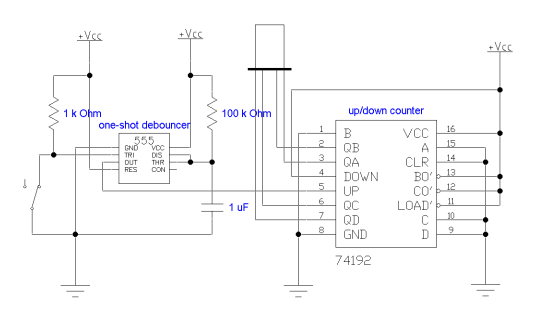
EWB circuit diagram
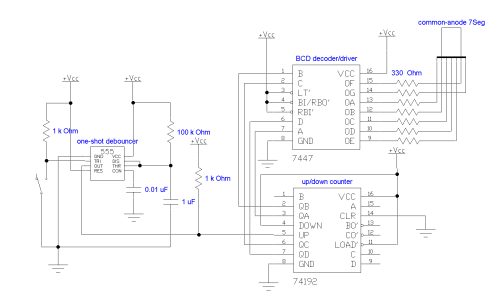
Circuit with Additional Details
IC 74192 Working
The 74192 is a 4-bit Up/Down Decade Counter with versatile operation modes. In the up-count mode, it increments with each rising edge of the clock input when the UP/DOWN input is high, allowing it to count from 0 to 9 and recycle. Preloading and clearing functions provide flexibility. In the down-count mode (UP/DOWN low), it decrements from 9 to 0 and recycles. The IC can also preset specific values using asynchronous parallel load and cascade with other counters for multi-digit counting systems. Its synchronous operation is synchronized to the clock signal and control inputs, ensuring precise counting.
Only logged in customers who have purchased this product may leave a review.

- Image
- SKU
- Rating
- Price
- Stock
- Availability
- Add to cart
- Description
- Content
- Weight
- Dimensions
- Additional information
Reviews
There are no reviews yet.