
No products in the cart.
8%

7485 (4-bit magnitude comparator)
In Stock
In Stock
Add to WishlistRemove from Wishlist
CompareAdd to Wishlist
Description
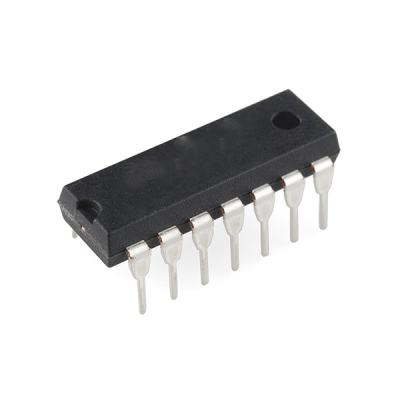
The IC 7485 is a 4-bit magnitude comparator from the 7400 series of TTL (Transistor-Transistor Logic) ICs. It is used to compare two 4-bit binary numbers and determine their relative magnitude, meaning whether one number is equal to, greater than, or less than the other. The IC provides three outputs to indicate the result of the comparison.
IC 7485 Description:
The 7485 is a 4-bit magnitude comparator that takes in two 4-bit binary numbers (A3-A0 and B3-B0) and compares them bit by bit. The outputs indicate whether the first number (A) is greater than, equal to, or less than the second number (B). It is widely used in digital systems for comparison tasks, such as sorting, decision making, or controlling logic based on numerical relationships.
Key Features:
- 4-bit Magnitude Comparator: Compares two 4-bit binary numbers.
- Greater Than, Equal To, Less Than Outputs: The IC has three outputs that indicate the result of the comparison:
- A > B: Indicates if A is greater than B.
- A = B: Indicates if A is equal to B.
- A < B: Indicates if A is less than B.
- TTL Logic: The IC uses TTL logic, making it compatible with other TTL devices in digital systems.
- Open Collector Outputs: The comparison outputs are open-collector, meaning external pull-up resistors are required for proper operation of the output signals.
Pin Configuration (16-pin package):
| Pin | Function |
|---|---|
| 1 | A3 (Input) |
| 2 | B3 (Input) |
| 3 | A2 (Input) |
| 4 | B2 (Input) |
| 5 | A1 (Input) |
| 6 | B1 (Input) |
| 7 | A0 (Input) |
| 8 | B0 (Input) |
| 9 | Ground (GND) |
| 10 | A > B (Output) |
| 11 | A = B (Output) |
| 12 | A < B (Output) |
| 13 | Vcc (Power Supply) |
| 14 | A > B (Output) |
| 15 | A = B (Output) |
| 16 | A < B (Output) |
Functional Description:
- 4-Bit Binary Comparison:
- The 7485 compares two 4-bit binary numbers (A3-A0 and B3-B0). The comparison is done bit by bit, starting from the most significant bit (MSB) to the least significant bit (LSB).
- If the first number (A) is greater than the second number (B), the A > B output will be low (active), and the others will be high.
- If the numbers are equal, the A = B output will be low, and the others will be high.
- If the first number (A) is less than the second number (B), the A < B output will be low, and the others will be high.
- Open-Collector Outputs:
- The comparison outputs are open collector, meaning they require external pull-up resistors to function properly. When the output is low (active), the internal transistor of the IC connects the output to ground. When the output is high (inactive), the transistor disconnects, and the output is left floating, requiring an external resistor to pull the voltage high.
- Three Output Signals:
- The 7485 provides three output signals to indicate the result of the comparison:
- A > B: Low when A is greater than B, high otherwise.
- A = B: Low when A is equal to B, high otherwise.
- A < B: Low when A is less than B, high otherwise.
- The 7485 provides three output signals to indicate the result of the comparison:
- Applications in Digital Systems:
- The 7485 is widely used in digital systems for tasks where numerical comparisons are required. It can be used in sorting algorithms, control systems, or decision-making processes where the comparison between two values determines the next course of action.
- For example, in a sorting circuit, the IC can be used to compare values in an array and reorder them based on whether one value is greater or smaller than another.
Applications:
- Sorting Algorithms:
- The 7485 is often used in sorting systems where numerical data needs to be compared and ordered, such as in digital sorting circuits or algorithms like bubble sort or insertion sort.
- Control Systems:
- In digital control systems, the 7485 can be used to compare sensor readings or input signals to thresholds to decide actions like triggering alarms, activating relays, or switching control signals.
- Digital Comparators:
- The IC is used in digital comparator circuits to compare binary values for decision-making. It can be used in applications like ADC (Analog to Digital Converter), where digital comparison is part of the conversion process.
- Frequency and Period Measurement:
- The 7485 can be used in systems where periodic events or frequency measurements need to be compared, such as in time-frequency analysis or digital counters.
- ALUs (Arithmetic Logic Units):
- In an ALU, the 7485 can be used to compare two numbers as part of arithmetic operations, such as in conditional branching or decision-making based on comparison results.
- Digital Displays:
- In systems where binary numbers are displayed (such as digital clocks, counters, or digital thermometers), the 7485 can help in comparing the current value with a threshold and deciding whether to trigger an action or update the display.
Electrical Characteristics:
- Supply Voltage (Vcc): Typically 5V (operates from 4.75V to 5.25V).
- Input Voltage (Vih/Vil): The input voltage levels are based on TTL logic:
- Vih (High Input): Typically 2V.
- Vil (Low Input): Typically 0.8V.
- Output Voltage (Voh/Vol): The outputs are open-collector, so the voltage on the output depends on the external pull-up resistors. When the output is low (active), it connects to ground; when the output is high (inactive), it is pulled up by the external resistor.
- Power Consumption: The 7485 typically consumes a small amount of power, as it is designed for use in TTL-based logic circuits.
Only logged in customers who have purchased this product may leave a review.
- Image
- SKU
- Rating
- Price
- Stock
- Availability
- Add to cart
- Description
- Content
- Weight
- Dimensions
- Additional information
Reviews
There are no reviews yet.