
No products in the cart.
17%
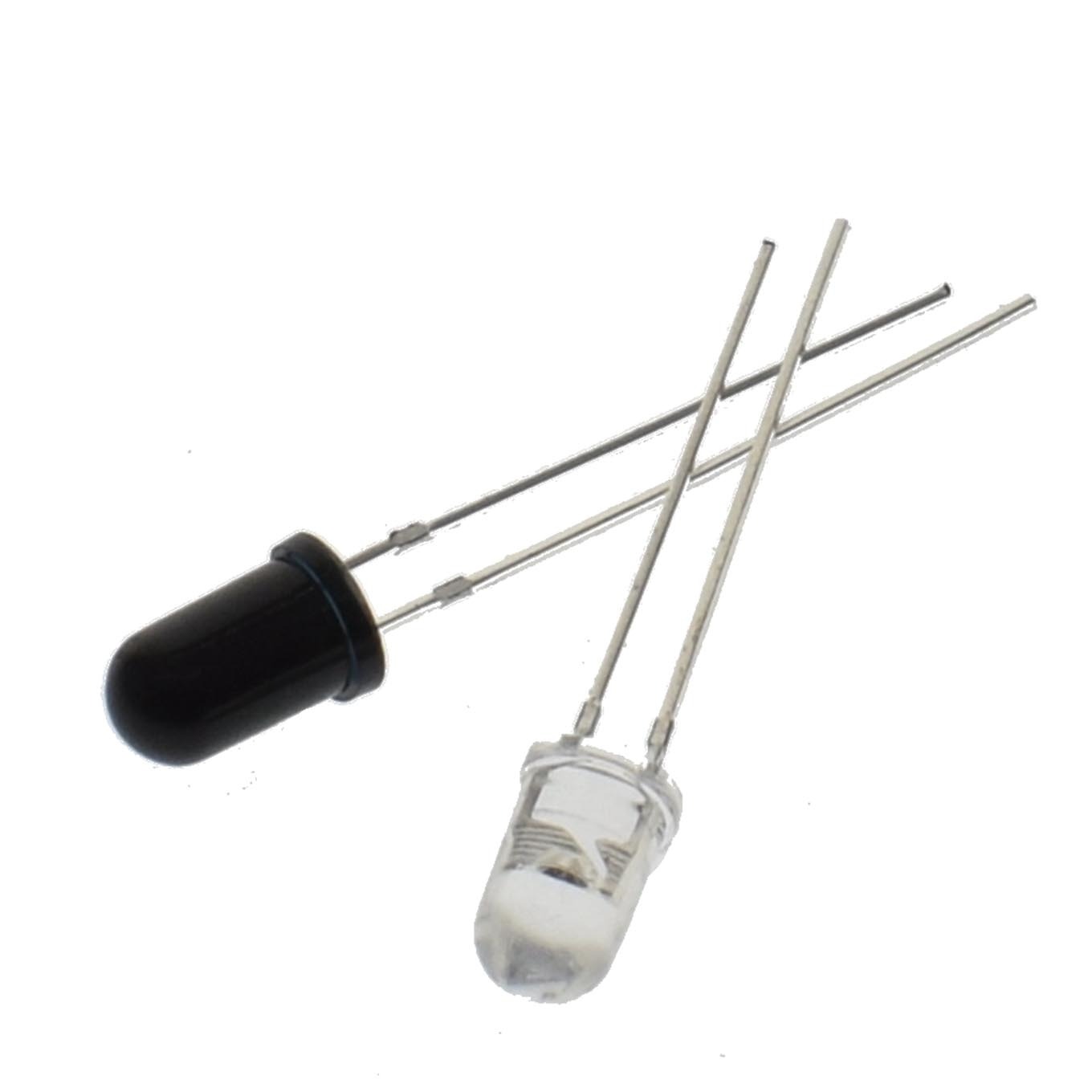
IR 5mm Infrared Led (Receiver + Transmitter)
Out of stock
Out of stock
Add to WishlistRemove from Wishlist
Add to Wishlist
Description
The IR 5mm Infrared LED is a popular electronic component used for both infrared (IR) transmission and reception. It typically comes in a 5mm package and is used in a wide variety of applications including communication, proximity sensing, remote control systems, and data transfer systems.
Overview of IR 5mm LED (Receiver + Transmitter):
- Type: 5mm infrared LED (Light Emitting Diode)
- Package: 5mm package, typically with a clear or tinted lens.
- Function: Can be used for both IR transmission (LED transmitting IR light) and IR reception (photodiode detecting IR light).
- Wavelength: Typically operates around 850nm to 940nm, which is in the infrared spectrum (invisible to the human eye).
- Emission Angle: Typically around 20° to 30°, although this may vary based on the specific model.
- Forward Voltage (Vf): 1.2V to 1.5V (this is the typical voltage drop when current flows through the LED in transmission mode).
- Forward Current: Typically 20mA (standard operating current for the LED).
- Power Output: Generally low power output due to its use in short-range communication or sensing.
IR LED Transmitter (Emitter):
The transmitter part of the IR LED emits infrared light when current is passed through it. The LED emits light in the infrared spectrum (invisible to the human eye) but can be detected by IR sensors or photodiodes tuned to the same wavelength.
Working of an IR LED Transmitter:
- When a voltage is applied to the LED, electrons recombine with holes in the semiconductor material, releasing energy in the form of infrared light.
- The emitted infrared light is used for communication (e.g., IR remote controls), or for distance sensing (e.g., obstacle detection).
IR LED Receiver:
The receiver part is generally a photodiode or phototransistor that detects the infrared light emitted by an IR LED (or another IR light source). The receiver detects the incoming light and converts it into an electrical signal that can be processed by a microcontroller or other processing circuits.
Working of an IR LED Receiver:
- The receiver (photodiode or phototransistor) absorbs the infrared light, and depending on the intensity of the light, it generates a photocurrent.
- The receiver is sensitive to a specific wavelength of infrared light (usually around 850–940 nm). It may have a narrow or wide viewing angle, depending on its design, to focus on the emitted IR light.
Applications of IR 5mm LED (Receiver + Transmitter):
- Remote Control Systems:
- IR transmitters are used in remote controls (such as TV remote controls) where a modulated infrared signal is emitted from the IR LED, carrying control signals that can be received by a corresponding IR receiver.
- Proximity and Object Detection:
- The IR LED (transmitter) emits infrared light, which bounces off objects and returns to the receiver. This method is used for simple distance sensing or obstacle detection in robotic applications, security systems, and even some smartphones.
- Data Communication:
- IR LEDs and receivers are used in serial data communication for short-range wireless data transmission. It’s used in systems like IrDA (Infrared Data Association), which is used for communication between devices like mobile phones or between a computer and peripheral devices.
- Motion Detection Systems:
- When placed strategically, an IR transmitter and receiver form a system that can detect motion based on the interruption of the IR beam by an object or person.
- Barcode Scanners:
- In barcode scanning systems, an IR LED is used to illuminate the barcode, and the reflected infrared light is detected by a photodiode receiver, allowing the barcode scanner to read the encoded data.
- Night Vision Cameras:
- IR LEDs are often used in security cameras for night vision, where infrared light is used to illuminate an area without visible light. The camera uses a receiver to detect the reflected IR light and create a visible image.
- Laser Tripwires:
- In security systems, an IR emitter and receiver pair can form a laser tripwire. When the IR beam is broken by an intruder, an alarm is triggered.
Pin Configuration for 5mm IR LED:
If you are using a 5mm IR LED in a typical circuit, the LED will have the following pinout:
- Anode (+): The longer leg of the LED, connected to the positive supply voltage.
- Cathode (-): The shorter leg, connected to the ground or negative voltage.
For the IR Receiver (photodiode), the pins will typically be:
- Anode (+): Connected to the positive supply voltage.
- Cathode (-): Connected to the ground, and the signal output can be taken from the cathode or a dedicated output pin.
Basic Circuit for IR LED Transmitter:
- IR LED with Current Limiting Resistor:
- To ensure the IR LED operates properly and doesn’t burn out, you’ll typically use a current-limiting resistor.
- Example: If the supply voltage is 5V and the forward voltage of the IR LED is 1.2V, you can use a resistor to drop the excess voltage. A resistor value of around 150Ω would work for a 20mA current.
Formula for resistor:
R=Vsupply−VfIfR = \frac{V_{supply} – V_f}{I_f}where:
- Vsupply=5VV_{supply} = 5V
- Vf=1.2VV_f = 1.2V
- If=20mA=0.02AI_f = 20mA = 0.02A
So:
R=5V−1.2V0.02A=190ΩR = \frac{5V – 1.2V}{0.02A} = 190\OmegaChoose a resistor value close to this, like 150Ω or 220Ω, depending on the exact forward voltage and current requirements of the IR LED.
Basic Circuit for IR LED Receiver:
- Photodiode with Signal Amplification:
- A photodiode or phototransistor can be connected to an amplifier circuit to detect the reflected infrared light and convert it into a signal that can be processed (for example, by a microcontroller).
- Comparator Circuit:
- Often, a comparator is used to detect whether the light level has crossed a certain threshold. When the threshold is crossed, the comparator outputs a HIGH or LOW signal.
Considerations:
- Wavelength Matching: Ensure that the transmitter and receiver are designed for the same infrared wavelength (typically 850–940 nm).
- Distance & Angle: The range of communication between the transmitter and receiver depends on factors like the power of the transmitter, the sensitivity of the receiver, and the ambient conditions (e.g., sunlight).
- Line of Sight: IR communication systems generally require a line of sight between the transmitter and receiver. Any obstruction in the path of the IR light will disrupt the signal.
Conclusion:
The 5mm Infrared LED (Receiver + Transmitter) is a compact and versatile component used in a wide range of applications, including remote controls, object detection, data communication, and security systems. The IR LED’s ability to emit and detect infrared light enables it to be used in various contexts where short-range, wireless communication or sensing is required.
Only logged in customers who have purchased this product may leave a review.
Related products


- Image
- SKU
- Rating
- Price
- Stock
- Availability
- Add to cart
- Description
- Content
- Weight
- Dimensions
- Additional information
Reviews
There are no reviews yet.